
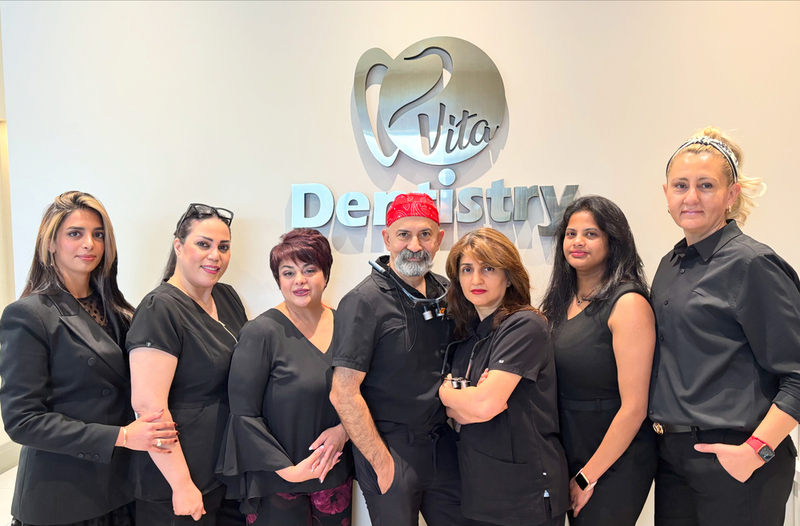
Moving to a new neighbourhood, changing jobs, or simply deciding it’s time for a change — any of these can leave a whole family without a dentist. And the search usually starts the same way: a quick look at the nearest clinics, a glance at the star ratings, and then a guess. For a decision that can last years — for you, your partner, your kids and your parents — that deserves a better method than a guess.
This guide to choosing a family dentist in North York gives you that method. It walks through what “family dentist” actually means, what you can verify about any dentist before you book, the questions worth asking about insurance and the Canadian Dental Care Plan, and how a first visit and a switch between clinics normally work. It is written for patients comparing any clinic in North York — and it points to how things work at Vita Dentistry where Vita’s own facts are the answer.
Table of Contents
In this article
What “Family Dentist” Really Means (One Practice, Every Age)
A family dentist is not a separate specialty. It is a general dental practice that looks after patients of every age — children’s first check-ups, adults’ fillings and crowns, and older adults’ denture care — under one roof, with one set of records for the household. That continuity is the point: the dentist who has watched your child’s teeth develop is the same one who knows your own history when a problem shows up.
In practice, “family” dentistry covers everyday dental care for all ages: check-ups and cleanings, X-rays, fillings, gum care, root canal treatment, crowns and bridges, dentures, and extractions. When a case needs a specialist — a complex root canal, a difficult wisdom tooth, advanced gum disease — a general dentist refers to one rather than treating beyond their scope. That honesty about scope is itself a quality signal: a practice that says plainly when it refers is one you can trust to say the same about your own treatment.
The distinction that matters for a choosing guide is this: a family practice is a place, not a person with a particular title. If you see “family dentist” on a clinic’s door, it means the practice welcomes the whole household — not that the dentists hold a specialty credential in family dentistry, because no such dental specialty exists in Ontario.
The Checklist: Credentials and Registration You Can Verify
Before you book anywhere, spend five minutes on the one check that actually proves a dentist is licensed to practise in Ontario. Every dentist in the province must be registered with the Royal College of Dental Surgeons of Ontario (RCDSO), the regulator that licenses dentists and sets the advertising and practice standards they must follow. You can check a dentist’s registration on the RCDSO website — the public register search lets you confirm a dentist’s name, registration status and practice information for yourself, before you ever sit in their chair.
The rest of the checklist is questions worth asking any clinic, and the answers should be straightforward:
- Who will actually treat you? A general dentist, or a mix of dentists? At Vita Dentistry the treating dentists are Dr. Mahbod Tabaei and Dr. Mahnaz Allambeigi — general dentists who provide the clinic’s full range of care and refer complex cases to specialists when that’s the right call.
- What does the clinic’s online presence show? A real address, a real phone number, real doctors with real names — and copy that avoids superlatives and guarantees. Ontario’s advertising rules for dentists forbid misleading claims, so a clinic that promises results or calls itself “the best” is telling you something about itself, and it isn’t good.
- Is the clinic set up for your household? Children’s care, older adults’ care, accessibility for anyone with mobility needs — ask directly rather than assuming.
- Can you see real patient feedback? Reviews from real patients (Google reviews, not anonymous testimonials on a website) are a useful cross-check — but they are one signal among several, not the decision itself.
Questions to Ask About Insurance and the CDCP
Money questions feel awkward, but they belong in the choosing conversation — before the first appointment, not after a treatment plan is printed. Ask any clinic these four:
- Do you accept my dental insurance, and do you direct-bill it? If you have a workplace plan, confirm whether the clinic bills the insurer directly or whether you pay and claim back.
- Do you accept CDCP patients? Vita Dentistry does. If you have no dental insurance at all, the Canadian Dental Care Plan (CDCP) — the federal program that helps eligible residents pay for part of their dental care — may cover exams, X-rays, cleanings, fillings, root canal treatment, gum care and dentures, among other services. For the official list, see what the CDCP covers (Canada.ca), and for how CDCP care works at this clinic specifically, see the page for CDCP patients in North York.
- Who decides whether I’m eligible? The federal program does — not the clinic. Eligibility is based on criteria including having no access to dental insurance and an adjusted family net income below $90,000. A clinic can explain how CDCP coverage applies to a treatment plan; it cannot confirm your eligibility for you, and no one should ask you to pay in full for a covered service and claim it back yourself — the plan reimburses providers, not patients.
- What happens when something isn’t covered? Implants, orthodontic treatment and cosmetic treatment are not part of standard CDCP coverage. Ask how the clinic handles that conversation before treatment begins, so there are no surprises.
One caution that belongs in every choosing guide: if a clinic’s website or advertising makes promises about coverage — “fully covered”, “no cost to you” — treat that as a red flag, not a selling point (see the Red Flags section below). Coverage is always confirmed by the program and explained by the clinic, in that order.
Location, Hours and Getting the Whole Family Booked Together
A dentist your family will actually keep going to is one that fits your life, not just your map. Two practical facts for Vita Dentistry, verified from the clinic’s own contact page: the clinic is at 879 York Mills Rd, Unit 6, North York, ON M3B 1Y5, and its hours are Monday–Wednesday 9:30AM–6PM, Thursday 10AM–6PM, Friday 11AM–7PM, Saturday 9:30AM–4PM, Sunday closed. A Saturday-morning slot matters more to most families than a five-minute shorter drive — check the hours against your own week before you fall for a location.
Booking the whole household is a separate question from finding the clinic. Ask when you call whether family members can be booked back-to-back on one visit, and whether the clinic can hold a first-visit slot long enough for a parent and children together. There is no universal policy on this — it varies by clinic and by day — so the answer comes from the phone call, not from a website. When you do call, have the household’s basics ready: names and dates of birth, any insurance information, and a note of anything urgent (pain, a broken tooth, swelling) so the clinic can triage properly.
How a First Visit Usually Works
A first visit at a family practice is mostly information-gathering, and knowing that takes the pressure off. It usually unfolds like this:
- Paperwork and history. You will be asked about your medical history, current medications, allergies, and any dental history you remember. Bring a list of medications — it matters for treatment planning, including for local anesthetic choices.
- Examination and X-rays. The dentist examines your teeth and gums and takes X-rays as needed. This is the basis for everything that follows — a treatment plan made without an exam is a guess, and a good clinic won’t make one.
- Findings in plain language. You will hear what was found, what is urgent, what can wait, and what is recommended — in that order. Ask questions here; a dentist who welcomes them is a dentist you can work with.
- A plan, with choices. Treatment is staged and agreed with you. Nothing should be booked beyond what you have agreed to, and costs for anything not covered should be explained before treatment starts.

For a family, the first visit also sets the tone for children: short, calm, explained before anything happens. A child who has a good first experience is a child who will come back — and the same is true of adults who have stayed away for years.
Red Flags When Comparing Clinics
Most clinics are honest operations. A few warning signs are worth naming, because they are exactly the things Ontario’s dental advertising rules exist to prevent:
- Guaranteed outcomes or “pain-free” promises. No dental outcome can be guaranteed, and no responsible clinic promises it. Comfort should be described by what the clinic actually does — pacing, numbing, breaks — not by a slogan.
- Superlatives as the selling point. “Best dentist”, “top clinic”, “number one” are claims no clinic can prove, and the regulator’s advertising standards say so.
- A treatment plan without an examination. If a clinic quotes a plan — or a price — before examining you, that plan is not based on your mouth.
- Pressure to decide on the spot. A legitimate plan can wait for you to think it over and, if you want one, a second opinion.
- No verifiable registration. A dentist whose name doesn’t appear on the RCDSO register is not a dentist you should book with — full stop.
None of these is a reason to distrust a clinic that does things properly. They are the filter that lets you tell the two apart.
Making the Switch: Records, X-Rays and Timing
Switching dentists is routine, and a good clinic handles most of it for you. What usually happens:
- Records transfer. Your new clinic can request your records and recent X-rays from your previous dentist — you sign a consent for the transfer, and the clinics handle it between themselves. If your old X-rays are recent and of good quality, they may not need to be retaken; if they are old or unclear, new ones are taken at your first visit.
- Timing. There is no waiting period for switching. If you are mid-treatment — a crown in progress, a root canal not yet finished — tell the new clinic before your first visit so they can plan the handover; some in-progress work is best finished where it started, and an honest clinic will say so.
- Insurance continuity. If you are changing clinics mid-benefit-year, your new clinic can check what your plan has already paid toward this year’s limits. If you are a CDCP member, your coverage moves with you — it is a federal benefit, not a clinic’s — but tell the new clinic you are a member so the claim goes to the right place.
Switching is not a breach of loyalty and it is not a confrontation. Dentists expect it, and the only thing it requires from you is a phone call.
Choosing a family dentist in North York is a decision you make once and live with for years, so it is worth one afternoon of checking: verify registration, ask the insurance questions, match the hours to your week, and book a first visit that is mostly a conversation. If that first visit feels careful, unhurried and honest, you have probably found your clinic.
Vita Dentistry welcomes new patients and families in North York. For family dental care at Vita Dentistry, call (647) 276-0076 or book a first visit — and bring the checklist above with you, because a clinic that welcomes it is a clinic worth staying with.
References
The guidance in this article reflects Canadian dental practice and patient-education resources from the Ontario Dental Association, the Canadian Dental Association and the Royal College of Dental Surgeons of Ontario (RCDSO). Dentists in Ontario are licensed by the RCDSO, and patients can verify a dentist’s registration on the RCDSO website.
Program details and coverage information for the Canadian Dental Care Plan are from the Government of Canada’s CDCP pages (Canada.ca), linked in the sections above. CDCP rules can change; if anything here differs from Canada.ca, Canada.ca is correct.
Frequently Asked Questions About Choosing a Family Dentist
How do I check if a dentist is licensed in Ontario?
Use the Royal College of Dental Surgeons of Ontario (RCDSO) public register. Every dentist practising in Ontario must be registered with the RCDSO, and its website’s dentist search lets you look a dentist up by name and confirm their registration status and practice details before you book. It takes about two minutes, it is free, and it is the single most reliable check on this list — star ratings and websites can’t tell you whether a dentist is licensed; the regulator’s register can. If a name doesn’t appear in the register, don’t book with that person.
Can one dentist look after both my kids and my parents?
Yes — that is exactly what a family practice is set up for. A general dentist treating a household can provide children’s first check-ups and cleanings, adults’ fillings, crowns and gum care, and older adults’ dentures, extractions and maintenance, all in one place with one shared picture of the family’s history. Where a specific case needs a specialist — a child who needs advanced behaviour management, a complex root canal, advanced gum disease — the dentist refers the family member to that specialist for that part of care and continues the rest. One roof, with referral when it matters, is the model.
Do you accept new patients — and how soon can a family get in?
Vita Dentistry welcomes new patients, including whole families joining together. How soon a first appointment can be booked depends on the clinic’s schedule that week, so the honest answer comes from a phone call: tell the clinic how many family members are coming and whether anyone has something urgent — pain, a broken tooth, swelling — because urgent needs are triaged ahead of routine first visits. You can call (647) 276-0076 or send a request through the booking page, and the team will confirm what is available.
What should I bring to a first appointment?
Bring photo identification, your dental insurance details if you have a plan (your member or policy information), and a list of your current medications and allergies — medications shape treatment decisions, so the list matters even if it feels unrelated to teeth. If you are a CDCP member, bring your member ID as well; your dental team uses it to confirm your coverage with the plan administrator.
If you have records at a previous dentist, you don’t need to bring them yourself — with your consent, the clinic can request your records and recent X-rays directly. For children, bring the same insurance and medication information, plus anything that helps them feel at ease; a first visit for a young child is kept short and simple on purpose.
Does the CDCP cover family check-ups and cleanings?
For members who are eligible, yes — exams, X-rays, cleanings (scaling), fluoride applications and sealants are among the services the Canadian Dental Care Plan covers, along with fillings, root canal treatment, gum care, dentures and tooth removal. Three honest cautions. First, eligibility is decided by the federal program — you must have no access to dental insurance and an adjusted family net income below $90,000 — not by the clinic.
Second, the plan pays a percentage of its own established fees, and your share (a co-payment) depends on your income band — it is not automatically the full cost of a visit. Third, some services need preauthorization, and implants, orthodontic treatment and cosmetic treatment are not covered at all. Vita Dentistry accepts CDCP patients, and the team will explain, before treatment begins, what the plan covers for your family’s plan of care — but coverage is never something to assume in advance.
How do I transfer my dental records and X-rays to a new dentist?
You don’t have to carry them yourself. When you join a new clinic, you sign a consent allowing it to request your records and recent X-rays from your previous dentist, and the two clinics handle the transfer directly. If your existing X-rays are recent and clear, the new dentist may use them rather than retaking them; if they are old, incomplete or unclear, new X-rays will be taken at your first visit as part of the examination. There is no penalty or awkwardness involved — records transfers are a routine part of dental care, and both clinics expect them.
What if someone in my family needs a specialist?
Then your family dentist refers them — that is part of the job, not a failure of it. General dentists provide the large majority of a family’s care; some cases are better treated by a specialist, such as an endodontist for a complex root canal, an oral surgeon for a difficult extraction, or a periodontist for advanced gum disease. At Vita Dentistry, Dr. Mahbod Tabaei and Dr. Mahnaz Allambeigi are general dentists: they provide the clinic’s care and will tell you plainly, and refer you, when a case needs a specialist’s hands. Your records and X-rays go with the referral, and your ongoing care comes back to the practice afterwards.
How often should our family actually go to the dentist?
There is no single interval that is right for everyone. How often a person should come in depends on their oral health — their cavity history, gum condition and risk factors — and is set by the dentist after examining them. Many healthy adults are seen on a recall of around six to nine months, while someone with active gum disease or a run of new cavities may be seen more often, and children are typically monitored as their teeth develop. If a clinic puts your whole household on one identical schedule without examining anyone first, that is a schedule based on habit, not on your family’s mouths.

