
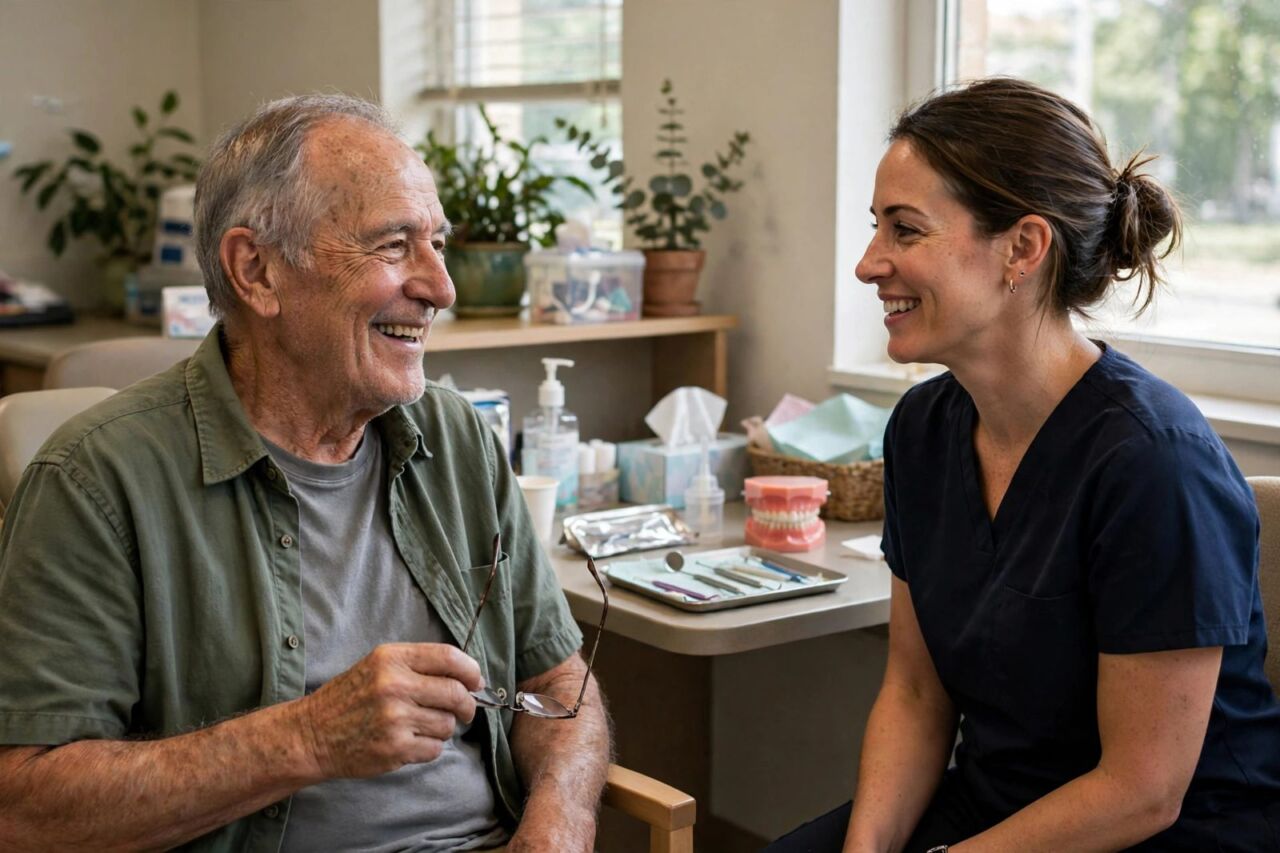
Turning 65 does not switch your teeth off — and it does not have to mean dentures are inevitable either. What does change is the risk picture: medications that dry your mouth, gums that have had decades to recede, old fillings and crowns reaching the end of their service, and, for many people, retirement taking workplace dental insurance away at exactly the moment care matters more. If you are looking into dental care for seniors in North York — for yourself, or for a parent — this guide covers what actually changes after 65, what does not have to, and how the Canadian Dental Care Plan (CDCP) fits into the picture.
Dental care for seniors in North York at Vita Dentistry starts from a simple position: keeping your own teeth, comfortably and for as long as they can genuinely be kept, is worth real effort — and when a tooth cannot be kept, the replacement conversation should be honest about every option. The coverage side of that picture lives on our CDCP page for North York patients, which this guide links up to rather than repeating.
On this page:
- What Changes in Your Mouth After 65 — and What Does Not Have To
- Keeping Your Natural Teeth: The Rhythm That Matters More Now
- Dry Mouth and Medications: The Quiet Risk
- Gum Disease and Your General Health, Stated Carefully
- When Teeth Cannot Be Saved: Dentures and Other Options, Honestly
- The CDCP for Seniors: Eligibility and What It Covers
- Dental Visits When Mobility Is Hard: Planning Ahead
- References
- Frequently Asked Questions About Dental Care for Seniors in North York
What Changes in Your Mouth After 65 — and What Does Not Have To
Some changes are simple wear and time: enamel thins, gums recede a little and expose root surfaces that decay more easily than enamel does, and older restorations — the fillings and crowns from your 40s and 50s — start reaching the end of their expected service. Taste can dull slightly, and healing after treatment can be a little slower. None of that makes tooth loss inevitable. Most teeth lost later in life are lost to gum disease and decay, and both are manageable at any age when they are caught at a check-up rather than at a crisis.
Keeping Your Natural Teeth: The Rhythm That Matters More Now
The check-up and cleaning rhythm matters more after 65, not less. Receded gums expose root surfaces, and root decay can move quickly; a small soft spot found at a routine visit is a filling, while the same spot found a year later can be a broken tooth. Regular professional cleanings and check-ups also give the dentist a chance to check the soft tissues of the mouth — including watching for sores or patches that do not heal, which should always be examined. At home, the basics stay the same but deserve more care: brush twice a day with fluoride toothpaste, clean between the teeth daily, and if your grip makes a standard brush hard to hold, ask about larger handles or an electric brush — small adaptations make a real difference.
Dry Mouth and Medications: The Quiet Risk
Saliva is your mouth’s built-in defence: it washes food away, neutralizes acids, and helps repair early decay. Many common medications — for blood pressure, mood, allergies, bladder and pain, among others — reduce saliva flow as a side effect. A permanently dry mouth is not just uncomfortable; it raises the risk of decay sharply, especially along the gumline and on exposed roots. If your mouth has become dry since starting a medication, tell your dentist rather than just putting up with it. The response can include fluoride strategies, saliva substitutes, sipping water regularly, sugar-free gum or lozenges to stimulate flow, and a shorter check-up interval — and never stop or change a prescribed medication on your own because of dry mouth; that conversation belongs with your physician and pharmacist.

Gum Disease and Your General Health, Stated Carefully
Research has found associations between gum disease and conditions such as diabetes and cardiovascular disease — people with one are more likely to have the other, and managing gum inflammation is part of good diabetes care. That is association language on purpose: the evidence does not prove that gum disease causes those conditions, and no honest guide should claim it does. What is safe to say is that an infected, inflamed mouth is a burden your body carries every day, that treating gum disease is worthwhile in its own right, and that your dentist and physician are looking at connected parts of the same person.
When Teeth Cannot Be Saved: Dentures and Other Options, Honestly
Sometimes a tooth genuinely cannot be kept — it is fractured below the gumline, too loose from advanced gum disease, or too broken down to restore predictably. When that happens, the options deserve a plain explanation. Dentures, full or partial, are a well-established removable option; our guide to choosing between full and partial dentures walks through that decision, and the service picture is on our full and partial dentures page. Keeping every healthy natural tooth you can matters here too: a partial denture that rests partly on sound natural teeth is usually more stable than one that cannot. Other replacement options exist and have their own candidacy limits — what matters is that the assessment tells you honestly which teeth are worth keeping and which are not, before any decision is made.
The CDCP for Seniors: Eligibility and What It Covers
Many seniors lost workplace dental benefits at retirement, and the Canadian Dental Care Plan was built largely with that gap in mind. In plain terms: the CDCP is a federal program for Canadian residents who do not have access to dental insurance through an employer, a pension plan or another organization, whose family income falls under the program’s threshold (a government eligibility criterion, currently a family income under $90,000), and who meet the program’s other criteria — the live criteria are on Canada.ca and on our CDCP page, and eligibility always comes first. For eligible patients, the CDCP covers a range of services — examinations, cleanings, fillings, dentures and other treatments — with coverage following the CDCP fee guide, which may not match a clinic’s full fee; it is never presented as complete coverage. One habit matters: CDCP coverage has a renewal cycle, and letting it lapse can interrupt treatment plans, so treat renewal like any other important paperwork and diarise it.
Dental Visits When Mobility Is Hard: Planning Ahead
If getting to appointments has become harder — mobility, transport, a move into assisted living — say so when you book. Visits can often be planned efficiently: combining assessment and treatment planning, scheduling at the time of day that suits you well, and making sure the important maintenance is done while access is easier rather than deferred until a problem forces a harder trip. Vita Dentistry is open Monday and Tuesday 9:30 a.m. to 5 p.m., Wednesday and Thursday 10 a.m. to 6 p.m., Friday 11 a.m. to 7 p.m., and Saturday 9:30 a.m. to 3 p.m.; the clinic is closed on Sundays. To book, call (647) 276-0076 or use the online booking page.
References
- Canadian Dental Association (CDA) — patient guidance on oral health for older adults, dry mouth and denture care.
- Ontario Dental Association (ODA) — patient resources, including information for seniors and caregivers.
- Royal College of Dental Surgeons of Ontario (RCDSO) — the regulator for dentists in Ontario; its public register lets you verify any Ontario dentist.
- Government of Canada — Canadian Dental Care Plan — official eligibility, coverage and renewal information.
Frequently Asked Questions About Dental Care for Seniors in North York
I have no dental insurance since retiring — does the CDCP apply to me?
It may. The CDCP is designed for Canadian residents without access to dental insurance through an employer, pension or other organization, who meet the program’s income and other criteria. Eligibility comes first and is confirmed through the federal application — the clinic can help you understand the process, and the official criteria are on Canada.ca and our CDCP page.
My medications make my mouth dry. Why does that matter for my teeth?
Saliva protects your teeth — it washes away food, neutralizes acid and helps repair early decay. When medication reduces saliva, decay risk rises, especially on exposed root surfaces near the gumline. Tell your dentist if your mouth has become dry; fluoride strategies, saliva substitutes and a shorter check-up interval can all help. Do not stop a prescribed medication because of dry mouth without speaking to your physician or pharmacist.
Are dentures my only option if I lose teeth?
No. Dentures are one well-established option, and for some patients they are the right one — but they are not the only one, and keeping healthy natural teeth is valuable in itself, including because a partial denture supported partly by sound teeth is usually more stable. An assessment explains which teeth can be kept and what each replacement option would involve for you, honestly, before you decide.
How often should seniors have dental check-ups?
There is no single interval that fits everyone. Many older patients are seen every six months, and some — with dry mouth, active gum disease or a history of root decay — benefit from shorter intervals. Your dentist will recommend an interval based on your mouth, not a fixed rule, and explain why.
Can I keep seeing my dentist if I move into assisted living?
Usually, yes — many patients in assisted living continue with their own dentist, with appointments planned around transport and the time of day that suits them well. Tell the clinic about the change so visits can be planned efficiently, and make sure your new residence and family know who your dentist is, so a dental problem reaches the right place quickly.
Does the CDCP cover dentures for seniors?
Dentures are among the services the CDCP may cover for eligible patients, following the CDCP fee guide and the program’s rules, which can include preauthorization for some services. Coverage is never presented as complete, and eligibility must be confirmed first — our CDCP page and Canada.ca carry the current details.
My dentures feel loose. Is that normal?
Some change over the years is expected: the bone and gums under a denture slowly change shape, so a denture that once fit well can loosen. A loose denture should be assessed rather than endured — relining, adjustment or, eventually, replacement are the usual conversations, and sore spots that do not heal should always be examined.
Is it worth treating a cavity at my age?
Almost always, yes — and the earlier the better. An untreated cavity does not stay still: it deepens, and a tooth that could have had a filling can end up needing much larger treatment or removal. Your general health, medications and comfort are all part of the decision, and your dentist should explain the options plainly — but age alone is not a reason to leave decay untreated.
If you are over 65 and it has been a while — or you are researching for a parent — a check-up is the honest place to start. Call Vita Dentistry in North York at (647) 276-0076 — Monday and Tuesday 9:30–5, Wednesday and Thursday 10–6, Friday 11–7, Saturday 9:30–3, closed Sundays.