

Missing teeth have a way of shrinking your world quietly. You stop smiling in photos. You order the soft thing on the menu instead of what you actually wanted. You plan conversations around the gap you hope nobody notices.
Dentures are how most people in that position get their world back — but the first question is usually the confusing one: full or partial? The answer is not about which denture is “better.” It depends on how many teeth you are missing, how healthy the teeth you still have are, and what those teeth can realistically support. This guide explains how that choice actually gets made, honestly — including the adjustment period nobody should sugar-coat, and what the Canadian Dental Care Plan (CDCP) does and does not cover.
If you want the service picture first, you can read about full and partial denture options at Vita Dentistry, then come back here for the decision guide.
Table of Contents
In this article
Full vs Partial Dentures, in Plain Terms
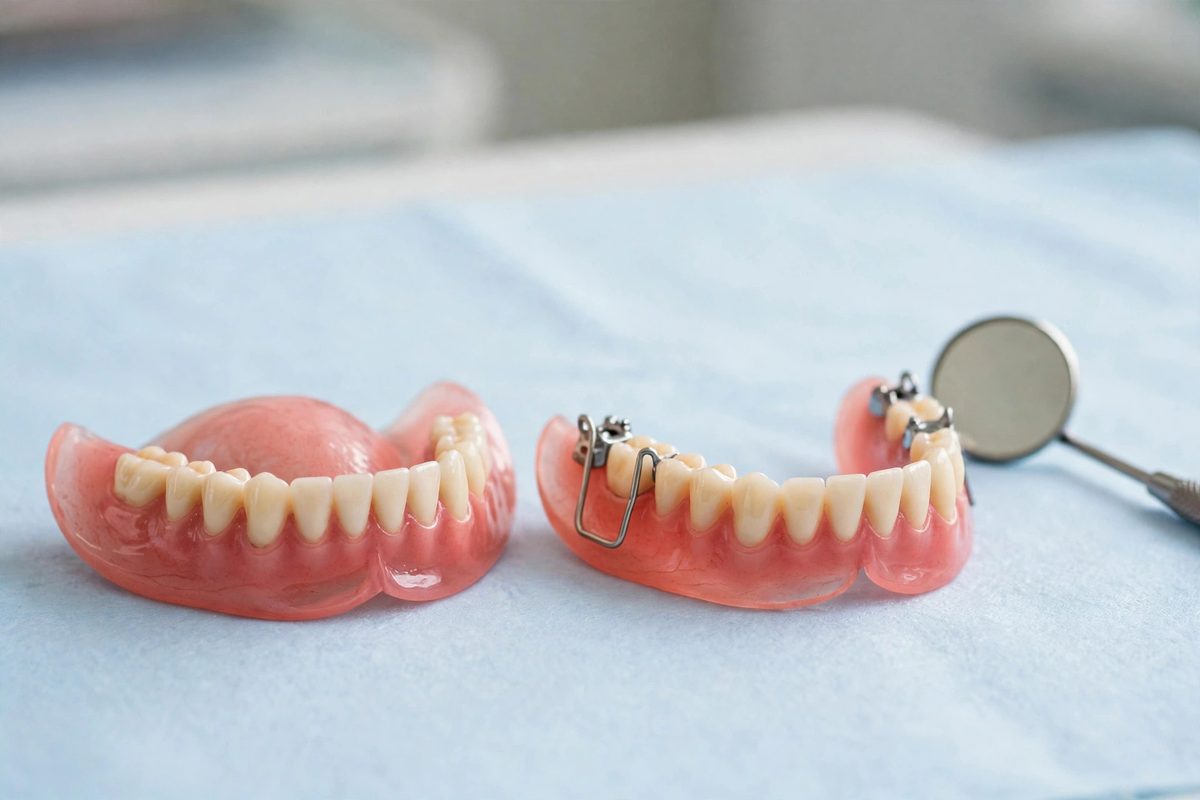
A full denture (also called a complete denture) replaces every tooth in one arch — the whole upper jaw, the whole lower jaw, or both. It is a gum-coloured acrylic base fitted to the shape of your gums, holding a full set of replacement teeth. An upper full denture covers the palate, which helps it stay in place by suction; a lower full denture sits on the lower gum ridge and is held by the tongue, cheeks and your own muscle control — which is why lower dentures are famously the harder of the two to get used to.
A partial denture replaces some teeth in an arch while your remaining natural teeth stay where they are. The replacement teeth are attached to a base — acrylic, or a framework that may include metal — and the denture holds on with small clasps that grip the natural teeth beside the gaps. It fills the spaces, keeps the neighbouring teeth from drifting into them, and spreads chewing across more teeth instead of overloading the ones that remain.
One point worth saying plainly: at Vita Dentistry, dentures are planned and provided by our general dentists. We are not a denturist clinic, and if your situation ever calls for specialist care, we will say so and discuss referral.
The Questions That Decide It: How Many Teeth, and How Healthy Are They?
The choice between full vs partial dentures is rarely a coin flip. It usually falls out of three questions:
- How many teeth are missing, and where? A few scattered gaps with sound teeth between them point to a partial. An arch with no teeth — or no teeth worth keeping — points to a full denture.
- How healthy are the teeth that remain? A partial denture leans on its neighbours. Teeth that are strong, with healthy gums and good bone support, make good anchors. Teeth that are loose from gum disease, badly decayed, or already failing cannot carry that load for long — building a partial around them usually means rebuilding it soon.
- What is the honest outlook for the remaining teeth? This is the question that matters most and gets asked least. If the remaining teeth in an arch are likely to be lost within a few years anyway, a well-planned full denture can be the kinder and more sensible path than a series of partials, repairs and extractions. If they have a good prognosis, keeping them — with a partial filling the gaps — preserves bone, bite and natural feel that no denture fully replaces.
None of this can be judged from the mirror. It takes an examination of the teeth and gums and X-rays showing the bone support — which is what the assessment at the end of this guide is for.
What Each Option Asks of You Day to Day
Both kinds of denture come out for cleaning and overnight. Beyond that, the daily realities differ:
- Eating. A partial denture works alongside your own teeth, so chewing usually feels closer to natural. A full denture — especially a lower one — takes real practice: smaller bites, chewing on both sides at once, and starting with softer foods while you learn. Our guide to eating with new dentures walks through that learning curve in detail.
- Speaking. Any new denture changes the space your tongue is used to. A brief period of careful speech is normal while you adapt; reading aloud at home genuinely helps.
- Cleaning. Dentures are cleaned daily with a soft brush and denture cleanser — never regular toothpaste, which is abrasive — and your gums, tongue and any remaining natural teeth still need their own cleaning. A partial denture’s clasps and the teeth they grip need particular attention, because plaque collects there.
- Keeping your own teeth. With a partial, your natural teeth still need check-ups, cleanings and fluoride like anyone else’s — arguably more, since they now carry extra responsibility.
Fit, Comfort and the Adjustment Period — Honestly
Here is the part that should never be glossed over: new dentures do not feel like natural teeth on day one, and a clinic that promises instant comfort is not being straight with you. What is normal in the first weeks:
- Sore spots where the new base presses — these are dealt with at adjustment appointments, where the fit is fine-tuned. Expect a few of these visits; they are part of the process, not a sign something went wrong.
- Extra saliva at first, as your mouth reacts to something new in it. It settles.
- A “full” feeling and changed taste, especially with an upper denture covering the palate.
- Eating and speaking that improve week by week, not overnight.
Most people adapt well over the first month or so, and adjustments make a large difference — which is why wearing a sore denture in silence is the one thing not to do. Call us at (647) 276-0076 if a spot is rubbing; that is exactly what the follow-up visits are for.
Relines, Repairs and Replacement Over the Years
A denture is not a fit-once, wear-forever appliance, because your mouth keeps changing underneath it. After teeth are removed, the jawbone beneath the gums slowly shrinks — fastest in the first year, then gradually for life. The denture does not shrink with it, so over time a well-made denture becomes a loose denture.
- A reline resurfaces the underside of the denture to match your gums as they are now. It is the standard fix for a denture that has gradually loosened.
- Repairs — a cracked base or a tooth off the denture — can often be done quickly, and a partial denture can sometimes have a tooth added to it if a natural tooth is later lost. Sometimes. If the framework or fit has changed too much, replacement is the honest answer instead.
- Replacement is eventually needed for every denture — commonly after several years of wear, loosening and bite change. At your regular check-ups we look at fit, wear and the health of the gums and any remaining teeth, and we will tell you where your denture is in that life cycle rather than waiting for it to fail at a family dinner.
Implant-Supported Options, Briefly and Honestly
Some patients — most often those struggling with a loose lower denture — ask about anchoring a denture to dental implants. A small number of implants placed in the jaw can hold a denture firmly in place, and for the right person the difference in stability is substantial. It is also a surgical treatment with its own requirements: enough healthy bone, good general health, a longer timeline, and a higher investment than a conventional denture. It suits some people very well and is the wrong plan for others, and it deserves its own unhurried conversation rather than a paragraph of hype. If it interests you, ask about it at your assessment and we will assess whether you are a candidate and explain what it would involve in your case.
What the CDCP Covers for Dentures
For eligible patients, the Canadian Dental Care Plan does include dentures — but read that sentence the careful way. Eligibility is decided by the federal program first: in general, you must have no access to dental insurance, have an adjusted family net income under $90,000, and have filed your taxes. Coverage then follows the CDCP fee guide and the plan’s rules, including preauthorization for denture services — and because the plan pays a percentage of its own established fees, a co-payment or additional amount may apply. It should never be read as the plan covering the full cost of a denture.
Our page on the CDCP in North York explains eligibility and how the plan works at Vita Dentistry, and the official rules are always on Canada.ca, linked in the FAQs below.
Your Next Step: The Assessment
Choosing between full and partial dentures comes down to your teeth — how many are missing, how strong the rest are, and what their honest outlook is. An assessment gives you those answers: an examination, X-rays of the bone support, and a plain-language explanation of the option that fits your mouth, including what it asks of you and what alternatives exist. You can book an appointment online or call (647) 276-0076. Bring your questions — and if you already wear a denture that troubles you, bring it too. Seeing how it fits tells us a great deal.
References
The guidance in this article reflects Canadian dental practice and patient-education resources from the Ontario Dental Association, the Canadian Dental Association and the Royal College of Dental Surgeons of Ontario (RCDSO). Dentists in Ontario are licensed by the RCDSO, and patients can verify a dentist’s registration on the RCDSO website. CDCP coverage details are from the Government of Canada’s Canadian Dental Care Plan pages (Canada.ca), linked below; if anything here differs from Canada.ca, Canada.ca is correct.
Frequently Asked Questions About Full and Partial Dentures
Can I keep my remaining healthy teeth with a partial denture?
Yes — that is exactly what a partial denture is for. It replaces the missing teeth while your sound natural teeth stay in place and keep doing their share of the work. In fact, keeping healthy natural teeth is valuable: they preserve the jawbone around their roots, give the partial something firm to hold onto, and keep chewing feeling closer to natural. The condition is that those teeth have to be genuinely healthy — strong, well-supported by gum and bone, and kept clean, especially where the denture’s clasps grip them. Your dentist will check the anchor teeth carefully at your assessment and at every check-up afterwards, because a partial denture is only as good as the teeth holding it.
How long do dentures last before they need replacing?
There is no fixed expiry date, but no denture lasts forever. The denture itself wears — the teeth flatten, the base can stain or crack — and, more importantly, your mouth changes shape beneath it as the jawbone slowly shrinks after tooth loss. For many people, a denture serves well for several years with relines to refresh the fit along the way, and then reaches a point where relining no longer restores it and replacement is the sensible step. Looseness, sore spots that keep returning, a changed bite, visible wear, or difficulty chewing are the usual signs. Regular check-ups let us track the fit and tell you honestly where your denture stands.
Will people be able to tell I’m wearing dentures?
A well-made modern denture is designed to look like natural teeth and gums — in size, shape and shade matched to you — and most people find that colleagues and even family simply notice that they look well, not that they are wearing a denture. Two honest caveats: a loose denture can move or click when you eat or speak, which is a fit problem to get adjusted rather than something to accept; and very new dentures can feel — and briefly sound — different while you adapt to speaking with them. Both improve with the adjustment appointments that are a normal part of denture care.
Does the CDCP cover dentures?
Dentures are among the services the Canadian Dental Care Plan covers for eligible patients, and denture services require preauthorization under the plan — see what the CDCP covers (Canada.ca). The conditions matter: your eligibility must be confirmed by the program first (no access to dental insurance, adjusted family net income under $90,000, taxes filed), your coverage must be active when treatment is provided, and the plan pays a percentage of its own established fees — so a co-payment or an additional charge is possible, and it is never automatically the full cost. Ask us to confirm your coverage and what your portion would be, in writing, before treatment begins.
What if my current dentures are loose?
Bring them in and let us look — a loose denture is a solvable problem more often than people expect, and the fix depends on the cause. If the denture is sound but your gums have changed shape since it was made, a reline resurfaces the fit. If a clasp on a partial has bent or a base has cracked, a repair may do it. If the denture is worn out, or the remaining teeth it depends on have changed, replacement may be the honest recommendation — and if a lower denture will not stay put no matter what, that is the conversation where implant support sometimes belongs. What not to do is reach for more and more adhesive to compensate, or stop wearing the denture and stop eating properly. Book an assessment and we will tell you which fix yours actually needs.
How many appointments does it take to make a denture?
Usually several, spread over a few weeks — and that is a feature, not inefficiency. Making a denture involves impressions of your gums, records of how your jaws meet, a try-in stage where the teeth are set in wax so you can see the look and we can check the bite before anything is final, and then the finished denture with adjustment visits afterwards. Each stage exists because small corrections are easy early and hard later. If teeth still need to be removed first, the plan also has to account for healing — either by waiting before the final impressions, or by fitting an immediate denture at the extraction visit and relining it as you heal. Your dentist will map out the sequence for your case at the assessment.
Will a partial denture damage the teeth it clasps onto?
A well-designed partial denture, kept clean, should not damage its anchor teeth — it is designed to rest on them and share the chewing load. The risk is not the clasp itself; it is plaque. A partial creates new ledges and contact points where plaque collects, and the anchor teeth carry extra responsibility, so they need extra care: careful brushing and flossing around the clasps, fluoride as your dentist advises, and regular check-ups so any early problem is caught while it is small. Patients who clean the denture and their natural teeth daily, and keep their recall visits, generally keep their anchor teeth healthy for many years.
Can I sleep in my dentures?
The standard guidance is no — dentures should come out overnight. Your gums need hours free of the denture’s pressure to recover, and sleeping in a denture raises the risk of gum irritation and fungal infection underneath it, as well as plaque build-up on both the denture and any natural teeth. Overnight, clean the denture and store it in water or a denture solution so it does not dry out and warp. If there is a particular reason you feel you cannot remove yours at night, mention it at your appointment — there may be a fit issue behind it that we can fix, or specific instructions for your situation.

