
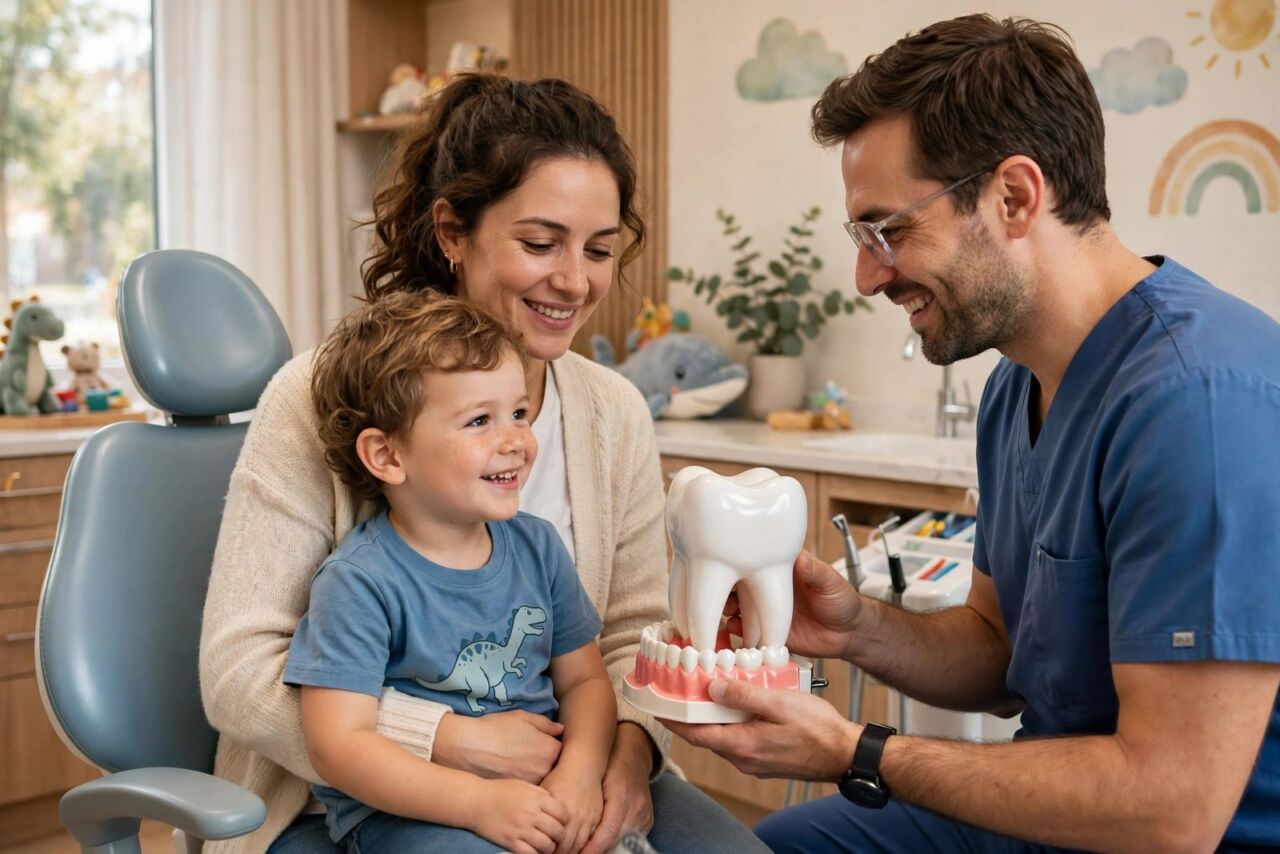
Most parents are surprised by how early a first dental visit is supposed to happen — usually before there is any problem, often before there are many teeth. If you are looking for a children’s dentist in North York because your baby’s first tooth has appeared, you are right on time, not early. This guide explains when to start, what actually happens at those first visits, and how to build the habit so check-ups stay ordinary, calm events as your child grows.
A note on who provides this care: at Vita Dentistry, children’s dentistry is provided by our general dentists, as part of children’s dental care at Vita Dentistry. If a child ever needs care beyond what a general practice should provide, we say so plainly and discuss referral to a children’s dental specialist.
On this page:
- When Should a Child First See a Dentist?
- What Happens at a First Visit
- Building the Habit: Check-Ups as Kids Grow
- Brushing, Flossing and Fluoride at Home, by Age
- Sealants: What They Are and When They Are Suggested
- Snacks, Bottles and Sippy Cups: The Decay Risks Parents Miss
- If Your Child Is Anxious: How Visits Are Paced
- When to Call Sooner: Pain, Injury, a Knocked Tooth
- References
- Frequently Asked Questions About Children’s First Dental Visits
When Should a Child First See a Dentist?
The Canadian Dental Association’s guidance is simple: a child’s first dental visit should happen by their first birthday, or within six months of the first tooth appearing — whichever comes first. That sounds early because it is meant to be a starting point, not a repair appointment. At that age there is rarely anything to fix. The point is to check that teeth are coming in as expected, look at the gums and mouth, talk through feeding and cleaning habits while they are still being formed, and — just as importantly — let your child meet the dental team before any visit ever involves a problem.
Children who start early almost always find later visits easier: the chair, the light and the sounds are already familiar, and a check-up is something they have always done, rather than something that only happens when something hurts.
What Happens at a First Visit
A first visit for a baby or toddler is short and deliberately unambitious. Depending on your child’s age and mood, it may include:
- A gentle look at the teeth, gums, tongue and jaw — often with your child sitting on your lap, which many clinics call a knee-to-knee examination.
- A count of the teeth that have arrived and a check on how the rest are developing.
- A light clean if your child is comfortable with it — and no pressure if they are not; forcing it helps nobody.
- A conversation with you about brushing, fluoride toothpaste amounts, bottles and cups, soothers, and snacks.
- An honest sense of when to come back, based on your child’s own decay risk rather than a one-size-fits-all schedule.
If your child cries, that is normal and not a failed visit — babies cry in unfamiliar places, and a good first visit can still end with useful information for you and a familiar room for them.
Building the Habit: Check-Ups as Kids Grow
After the first visit, most children are seen about every six months, though the interval is adjusted to the child: a child with a history of cavities may be seen more often, and fluoride applications or X-rays are suggested only when there is a reason for them. As children grow, visits gradually add the things you probably remember from your own childhood check-ups — a fuller clean, checks of how the bite is developing, and watching how baby teeth make way for adult teeth. Families often pair children’s visits with their own cleanings and check-ups for growing smiles and for the whole household, so the habit is shared rather than something done only to the child.
Brushing, Flossing and Fluoride at Home, by Age
- Before teeth: wipe gums with a clean, damp cloth after feeds.
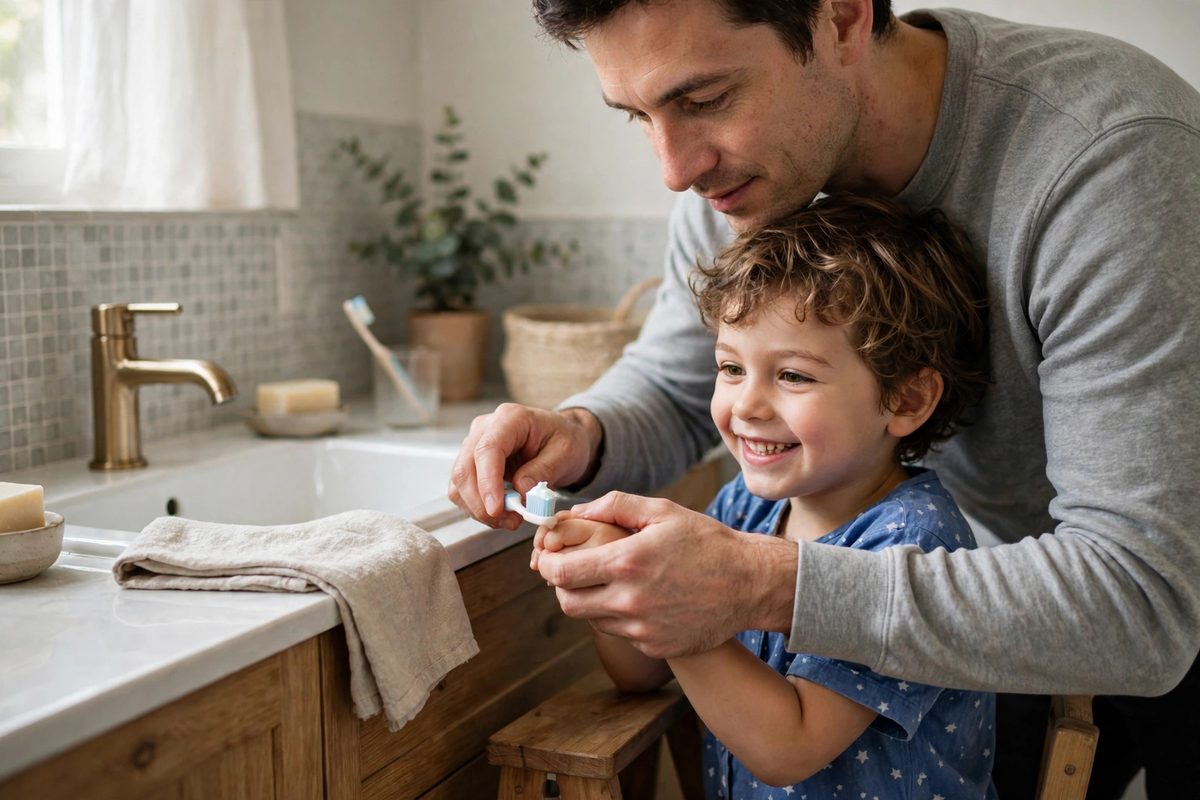
- First teeth to age 3: brush twice a day with a soft, child-sized brush. For children at risk of decay, a smear of fluoride toothpaste about the size of a grain of rice is the commonly recommended amount — your dentist will tell you whether your child is in that group.
- Ages 3 to 6: a pea-sized amount of fluoride toothpaste, with an adult doing or closely supervising the brushing. Children this age do not yet have the hand skills to clean thoroughly on their own, whatever they tell you.
- Flossing: start when two teeth touch side by side; floss picks made for children are a reasonable way to make it manageable.
- Fluoride generally: fluoride strengthens enamel and helps prevent decay, which is why it appears in toothpaste and in many municipal water supplies. Amounts for children are kept small and age-based for a reason — follow the amounts above rather than filling the brush.
Sealants: What They Are and When They Are Suggested
The chewing surfaces of back teeth have deep grooves where a toothbrush cannot fully reach and where food and plaque collect — which is why molars are where children most often get cavities. A sealant is a thin protective coating painted into those grooves and hardened in place, sealing the groove off so plaque and food stay out. Applying one involves cleaning the tooth, preparing the surface and painting the coating on; it is a preventive measure, suggested when permanent molars arrive (usually around age 6, and again around age 12) and most useful for children whose grooves are deep or whose decay risk is higher. Sealants wear and are checked at regular visits, and they work alongside brushing — never instead of it.
Snacks, Bottles and Sippy Cups: The Decay Risks Parents Miss
How often teeth meet sugar matters more than how much sugar there is in total, because every exposure restarts an acid attack on enamel. The patterns dentists most often trace decay back to are quiet ones: a bottle of milk or juice taken to bed (liquid pools around the teeth all night), a sippy cup of juice carried and sipped for hours, and frequent sticky snacks that cling to the grooves of molars. Water between meals, keeping sweet drinks to mealtimes, and never putting a child to bed with anything but water in the bottle are unglamorous habits that prevent a large share of early childhood cavities.
If Your Child Is Anxious: How Visits Are Paced
Some children are wary of new places, and some have had a difficult experience elsewhere. Visits for an anxious child are paced to the child: introductions before instruments, showing and naming things before using them, stopping when a child needs a break, and ending on something completed successfully rather than pushing through a full list. Parents help most by keeping their own language neutral and positive — talking about the visit as a routine outing, avoiding words like “hurt” or “needle” in advance, and letting the dental team explain procedures in the words they use with children every day. Comfort comes from pacing, familiarity and honesty; no visit should ever be promised as something it is not.
When to Call Sooner: Pain, Injury, a Knocked Tooth
Do not wait for the next routine visit if your child has tooth pain, swelling of the face or gum, a broken tooth, or a tooth injured in a fall. Call the clinic and describe what happened; you will be told how quickly your child should be seen. One specific point worth knowing before you ever need it: if a baby tooth is knocked completely out, do not try to put it back — reinserting a baby tooth can damage the adult tooth developing underneath. A knocked-out permanent tooth is different and is time-critical, so call immediately for instructions either way.
References
- Canadian Dental Association — your child’s first visit and early childhood oral health: cda-adc.ca
- Ontario Dental Association — patient oral health resources: oda.ca
- Government of Canada — Canadian Dental Care Plan: canada.ca
- Royal College of Dental Surgeons of Ontario — public register and patient resources: rcdso.org
Frequently Asked Questions About Children’s First Dental Visits
My toddler won’t sit still — is a first visit still worth it?
Yes. A first visit is planned around exactly that: it can be short, your child can stay on your lap, and an examination done in brief looks still gives the dentist useful information. The visit’s real purposes — checking development, setting up home-care habits, and making the clinic familiar — do not require a perfectly still child.
Are dental X-rays safe for children?
Dental X-rays use low doses of radiation and are taken only when there is a clinical reason — for example, to check areas that cannot be seen, such as between teeth or below the gumline — not automatically at every visit. Protective measures such as a lead apron are used. If an X-ray is suggested for your child, it is reasonable to ask what it is expected to show; the answer should be specific.
Does the CDCP cover children’s dental visits?
For eligible families, the Canadian Dental Care Plan covers many routine children’s services, including examinations, cleanings, fluoride and fillings, according to the CDCP fee guide. Eligibility comes first — the plan is for Canadian residents without access to dental insurance whose adjusted family net income is under $90,000 — and coverage is a percentage set by the plan, not automatically the full amount. Families should confirm their eligibility and what the plan pays before treatment, and our team can explain how that works at booking.
How often should kids have check-ups?
About every six months is the common pattern, but the right interval depends on your child’s decay risk and development. A child who has had cavities may be seen more often; a child at low risk may need less frequent visits. The interval is set at each visit based on what was actually found.
What do I do if my child chips or knocks out a tooth?
Call the clinic promptly and describe the injury. If a baby tooth is knocked out completely, do not try to reinsert it. If a permanent tooth is knocked out, it is time-critical — handle it by the crown (the part you normally see), not the root, and follow the instructions you are given when you call. Either way, an injured tooth should be assessed even if your child seems fine afterwards.
When should my child start using fluoride toothpaste?
Fluoride toothpaste in the right amount is recommended from the first teeth for children at risk of decay: a rice-grain-sized smear under age 3, and a pea-sized amount from ages 3 to 6, always applied or supervised by an adult. Your dentist will confirm the right amount for your child at the first visit, based on their decay risk and other fluoride sources.
Are baby teeth really that important if they fall out anyway?
Yes. Baby teeth hold space for the adult teeth developing underneath, and they matter for eating, speech development and smiling with confidence. A decayed or infected baby tooth can hurt, affect eating and sleep, and in some cases affect the adult tooth beneath it — which is why decay in baby teeth is treated rather than simply waited out.
How do I book my child’s first visit at Vita Dentistry?
You can book your child’s first visit online, or call Vita Dentistry in North York at (647) 276-0076. Tell the team your child’s age and that it is a first visit, and the appointment will be paced accordingly — short, gentle and introductory.

